
From AI to space medicine: William Harvey Day showcases research and innovation
Queen Mary University of London’s Faculty of Medicine and Dentistry celebrated scientific discovery and innovation at William Harvey Day 2026, held at St Bartholomew’s Hospital on 22 October.
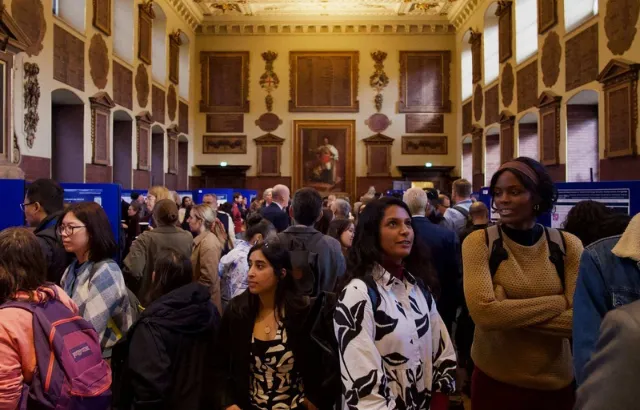
William Harvey Day 2026 poster session, The Great Hall, St Bartholomew's Hospital
The annual event brought together researchers, clinicians, students and partners for a programme of keynote lectures, scientific presentations and research posters spanning artificial intelligence, cardiovascular medicine, cancer biology, public health and space medicine.
Opening the event, Professor Sir Mark Caulfield, Vice-President for Health at Queen Mary, highlighted the Faculty’s research achievements and thanked St Bartholomew’s Hospital, the Worshipful Society of Apothecaries and Barts Charity for their partnership and support.
From artificial intelligence to space medicine
Four keynote lectures explored developments across medicine, science and technology.
Professor Pearse Keane, Professor of Artificial Medical Intelligence at University College London and consultant ophthalmologist at Moorfields Eye Hospital, delivered the Sir Anthony Dawson Lecture on the application of artificial intelligence in healthcare.
Professor Charalambos Antoniades, BHF Chair of Cardiovascular Medicine at the University of Oxford, delivered the William Harvey Lecture, examining how inflammation can be used to assess cardiovascular risk.
Professor Anu Ojha OBE, Space Chief Technology Officer at the UK Space Agency, delivered the Barts and The London Alumni Association (BATLAA) Lecture on human spaceflight and its medical challenges.
Dr Melanie Ivarsson OBE, Chief Executive Officer of the Health Data Research Service, delivered the Schorstein Lecture, exploring the future of health research and the opportunities presented by health data.
Showcasing Queen Mary’s research
Researchers from across the Faculty presented their work in four scientific sessions.
Big Datasets and AI covered digital pathology, clinical trials and tobacco harm reduction, while Mechanisms in Cardiovascular Disease explored wearable technologies, inflammatory responses to major trauma and new approaches to treating heart disease.
Sustaining Lifelong Health featured research into rehabilitation, healthy ageing and connections between the gut microbiota and the brain.
The final session, Discovery – Molecular Pathways, showcased fundamental research into T-cell biology, cancer therapeutics and the mechanisms involved in cancer invasion.
Recognising research achievements
William Harvey Day also celebrated recent successes across the Faculty, including more than £20 million in Wellcome funding for three doctoral training programmes for health professionals and research advances in cancer prevention, air quality and dementia diagnosis.
A research poster exhibition provided opportunities for researchers and students to present their findings and discuss their work with colleagues. This year’s event also featured posters from students participating in the Curriculum Research Training (CResT) Summer Scholarship Programme, generously funded by the St Bartholomew’s Hospital Charitable Fund and the Medical College of St Bartholomew’s Hospital Trust.
Professor Amrita Ahluwalia, Dean for Research at Queen Mary’s Faculty of Medicine and Dentistry, said:
“The standard of entries to this year’s competition was exceptionally high, reflecting the breadth and quality of research taking place across our Faculty. Congratulations to all our prize winners, and thank you to everyone who took part. The competition is a wonderful opportunity to showcase the talent, creativity and commitment of our early-career research community.”
Professor Sir Mark Caulfield, Vice-President for Health at Queen Mary University of London, said:
“William Harvey Day is a wonderful opportunity to celebrate the exceptional talent, ambition and achievements of our research community. From fundamental discovery science to advances in clinical care and population health, the breadth of research showcased today demonstrates the strength of our Faculty and the importance of collaboration across disciplines.
“William Harvey’s legacy reminds us that scientific curiosity and discovery are the foundations of medical progress. By continuing to support outstanding research at every stage, we can build on that legacy and make a lasting difference to the health and lives of people in East London and beyond.”
The event concluded with the traditional St Luke’s Tide Service.
William Harvey Day commemorates the physician whose discovery of the circulation of blood transformed our understanding of human physiology and helped establish modern experimental medicine.
Competition winners
Group 1: Cancer, Molecular Biology and Drug Discovery
Leo Dudley – Barts Cancer Institute, Queen Mary
Aberrant DNA methylation during colorectal cancer initiation
Cecilia Morel – Barts Cancer Institute, Queen Mary
Pre-diagnostic prescription patterns in pancreatic cancer: a retrospective cohort study
Group 2: Digital Health, Data Science and Oral Health
Mustafa Asaad Mohammed Mohammed – Institute of Dentistry, Queen Mary
Chlorhexidine release from vinyl polysiloxane for formulation of a novel implant prosthesis screw channel sealing material
Group 3: Disease Prevention and Detection, Healthy Ageing and Lifecourse
Sonia Pombo – Wolfson Institute of Population Health, Queen Mary
Poor Diet and Nutritional Inequalities Among Children in Tower Hamlets, London
Group 4: Cardiovascular and Scholarship
Phoebe Ella Lambert – Institute of Health Sciences Education, Queen Mary
‘Add Women and Stir’: Gendered Role Modelling and its Influence on Medical Professional Identity Formation
Group 5: Inflammation, Infection and Immunity
Giulia Frazzei – William Harvey Research Institute, Queen Mary
Difficult-to-treat rheumatoid arthritis is characterized by active synovitis with distinct innate and adaptive immune signatures indicative of true biological refractoriness
Nicholas James Day – William Harvey Research Institute, Queen Mary
Plexiform vascular lesions as a pathogenic process in Dupuytren’s contracture
Apothecaries Prize
Jobie Budd – Barts Cancer Institute, Queen Mary
PharosAI: Building an AI-Ready Multimodal Cancer Dataset
Overall Winner
Sam Hodgson – Wolfson Institute of Population Health, Queen Mary
Exome-wide study of Type 2 Diabetes in South Asians with 13,674 cases and 41,024 controls highlights ancestry-enriched variants in HNF4A and GP2
CResT Summer Scholarship Programme Awards - Medical College of St Bartholomew’s Hospital Trust Simon Thorley Award
Joint first place
Zeeshan Khan Alam
Characterising lung structure and neutrophil infiltration in the lungs in a murine model of inflammatory arthritis
Zaeem Abdeen
Exploring the Utility of Pulse Pressure as a new Cardiovascular Disease Risk Biomarker: Validation Analyses within the SPRINT trial
Second place
Noel Daniel Tekeste
The Effect of Septin Perturbation on Cytoskeleton Organisation and Weibel-Palade Body Function in Endothelial Cells
Awards from the St Bartholomew’s Hospital Charitable Fund
George Cholmeley Cattlin Prize 2026
Awarded annually to a qualified medical practitioner for postgraduate clinical or laboratory research in medicine, surgery or allied sciences undertaken at Barts and The London School of Medicine and Dentistry or Barts NHS Trust.
Recipient: Dr Ben Jacobs
Research into multiple sclerosis genetics
Alfred Thomas Corrie Prize 2026
Awarded annually to a qualified medical practitioner for postgraduate clinical research in anatomy or surgery. The prize also recognises relevant in vitro studies of anatomy and pathology, including research using scanning techniques.
Recipient: Dr Marrianne De Brito
Research into steatocystoma multiplex
James and Henry Cooper & William Garlick Coventon Scholarship 2026
An annual scholarship supporting a medical practitioner undertaking research in medicine, surgery or allied sciences.
Recipient: Dr Tom McClelland
PPAR-gamma agonism and immunometabolism: a mechanistic substudy of the HIPPO trial
Related items
 News story:
Queen Mary-led digital listening test to be trialled across NHS to help improve dementia diagnosis
2 October 2026