Why understanding tyre wear is key to developing more sustainable transport
As the world focuses on decarbonising transport, attention is increasingly turning to the environmental impacts that exist beyond the exhaust pipe. Professor James Busfield, Professor of Materials and Head of the Soft Matter group at Queen Mary University of London, explains why understanding the mechanisms behind tyre wear could be key to creating transport systems that are safer, more efficient and more sustainable.
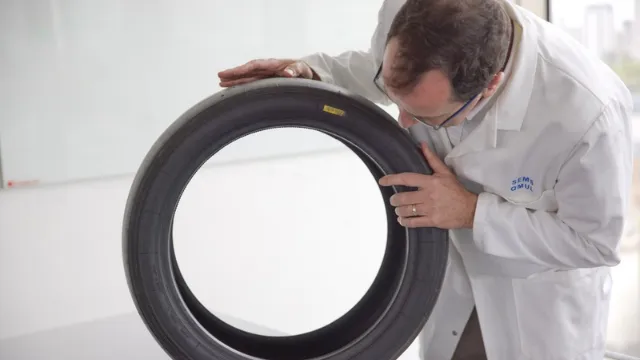
Every journey, whether in a petrol car, an electric vehicle, a bus or a lorry, depends on four a number of small patches of rubber whose real contact area under each tyre is approximately the size of postage stamp. Tyres are the only point of contact between a vehicle and the road. They keep us safe when we brake, turn corners and travel at speed. Yet despite their importance, they are often overlooked in conversations about the future of transport.
In a bid to change this, my research team and I have spent years investigating a deceptively simple question: what mechanisms cause tyres to wear in the first place, and what can that understanding teach us about building safer, more sustainable transport systems?
The answer matters far more than people realise.
Looking beyond measurement
Historically, tyre manufacturers have become remarkably good at measuring tyre performance. They can assess grip, durability, rolling resistance and lifespan through sophisticated testing programmes.
What is much harder to understand is exactly why tyres behave the way they do under real-world conditions.
A tyre does not wear in a simple or predictable way. The process is influenced by the tyre's composition, the condition of the road surface, the weather, vehicle weight and even the behaviour of the driver. Each of these factors interacts with the others in complex ways.
Traditionally, researchers and manufacturers have focused on the outcome: how much material is lost. We decided to ask a different question. Rather than measuring wear alone, what if we could understand the mechanisms that cause it?
This is the approach my work takes.
Rather than simply measuring tyre wear, our work sets out to understand the physical and chemical processes that govern wear and grip. By recreating tyre-road interactions in the laboratory, we have been able to investigate what happens when rubber experiences repeated stress, deformation and abrasion.
Understanding these mechanisms allows us to move beyond describing wear towards predicting it, which in turn creates opportunities for innovation to improve tyres in many ways.
The balancing act at the heart of tyre design
Designing a tyre is one of the great balancing acts in engineering.
Drivers expect tyres to provide outstanding grip in both wet and dry conditions. They expect them to last for thousands of miles, contribute to fuel efficiency and continue performing safely throughout their lifetime.
And improving one characteristic can often affect another.
A softer compound may improve grip but wear more quickly. A harder compound may last longer but compromise performance. Reducing rolling resistance can improve energy efficiency but introduces new design challenges elsewhere.
The result is a continuous search for better understanding.
One of the key questions my team is investigating is what happens at the point where the tyre meets the road. Rather than considering tyre wear as a single process, our research examines the different mechanisms that contribute to material loss and performance degradation over time. By separating and studying these individual mechanisms, we can begin to understand why tyres behave differently under different conditions.
This work has led us to investigate phenomena such as smear wear, where the tyre surface forms a thin protective layer during use. Unlike more aggressive forms of abrasion that remove material from a tyre, smear wear can help shield the surface from further damage, reducing the rate at which material is lost. Understanding how and when these mechanisms occur could help manufacturers design tyres that maintain high levels of performance while generating less wear. Recent work from our team has provided new insights into how these protective layers form, age and interact with the underlying rubber, helping move the industry from simply measuring wear towards understanding the processes that drive it. Ultimately, this deeper understanding could contribute to the development of tyres that are safer, more durable and more sustainable.
These insights that are team are producing are helping move the tyre industry and manufacturers beyond simply measuring the outcomes of wear towards understanding the science that drives it. By uncovering the physical processes taking place at the tyre-road interface, we are providing manufacturers with information that helps them balance competing demands around grip, durability, efficiency and sustainability more effectively.
The goal is not simply to build a better tyre. Instead, we are trying to understand the science better, to be able to make smarter decisions about performance, durability and sustainability.
The hidden environmental cost of every journey
For many years, questions around tyre improvements were primarily related to performance and safety. For example, tyres contribute significantly to the energy required to move a vehicle. Rolling resistance, the force that must be overcome as a tyre rolls across a surface, accounts for a substantial proportion of vehicle energy consumption. How can we improve tyres so that they use less of a vehicle’s energy?
Increasingly, however, these questions are also becoming about sustainability. This is because we know that as tyres wear, they release particles into the environment. In fact, 25-40% of microplastics that enter our waters come from tyres. Researchers around the world, including my own team, are increasingly seeking to understand where these particles go, how they change over time and what impact they may have on ecosystems.
These challenges point to a broader reality: sustainable transport is about more than reducing tailpipe emissions. It is also about understanding the materials we use, how products perform throughout their lifetime and the environmental consequences of tyre wear debris.
At Queen Mary, we are addressing these questions by investigating tyre wear at a fundamental level. Using our laboratory methods that replicate the complex interactions between tyres and road surfaces under real-world conditions, we can better understand energy loss and how and why tyre particles are generated. By identifying the mechanisms responsible for material loss, we are providing manufacturers with the knowledge needed to design tyres that maintain their performance and more sustainable in terms of efficiency, how they wear and what they release into the environment.
Our research also extends beyond the tyre itself. We are investigating what happens to tyre particles once they enter the environment, how their physical and chemical properties change over time, and how a better understanding of these processes could help reduce their impact.
A more circular future
As well as thinking about the particles that tyres wear as they shed and the impact this has on the environment, we must also consider the environmental cost of the whole tyre.
Globally, billions of tyres are manufactured every year and, eventually, millions become waste. Their durability, which makes them so effective on the road, also makes them notoriously difficult to recycle. Tyres are complex materials, engineered from a combination of natural and synthetic rubbers, reinforcing fillers and chemical crosslinks that provide the strength and resilience needed to withstand years of service. But those same properties create a significant challenge when we try to recover and reuse the materials at the end of a tyre's life.
At Queen Mary, we are exploring new approaches to chemical recycling that could help recover valuable materials from end-of-life tyres and keep them in circulation for longer. Rather than treating used tyres as waste, we are investigating ways to unlock and reuse the valuable materials they contain. Recent work from our researchers has shown how rubber materials can be designed to retain the performance needed for demanding applications while also being easier to recycle, helping support the transition towards a more circular tyre industry.
Rather than treating used tyres as waste, we are investigating ways to break down the chemical structures that hold these materials together, creating opportunities to recover resources that could potentially be reused in future manufacturing.
The ultimate goal is to support a more circular tyre industry, one in which valuable materials remain in use for longer and fewer resources are lost at the end of a product's life.
This reflects a wider shift in thinking across many industries. Sustainability is no longer simply about reducing environmental harm; it is increasingly about designing systems that use resources more intelligently from the outset. For tyres, that means considering every stage of their journey, from design and manufacture through to performance, wear, recovery and eventual reuse – and I am proud to say this is something that we are leading the way in at Queen Mary.
Asking different questions
Many of society's biggest challenges are not solved by working harder on the same problem. They are solved by asking a different question.
In our case, that question was not "how much do tyres wear?" but "why do they wear?"
That shift in perspective has led us to asking fundamental questions about material behaviour, transport efficiency, environmental impact and circularity.
The answers we are finding are helping industry better understand tyre performance today, while creating opportunities to develop safer, more efficient and more sustainable tyres in the future.
As we continue to rethink what sustainable transport means, it is worth remembering that progress often comes from understanding the hidden systems that make our journeys possible.
Every journey begins where rubber meets the road. Understanding what happens at that moment may prove to be one of the keys to building a more sustainable transport future.
Read more:
Related items
 News story:
Queen Mary lecturer publishes research on innovative teaching methods in transnational mathematics education
21 October 2026