
Projects available
Applications are invited for the AI for Drug Discovery Programme for the available projects listed below.
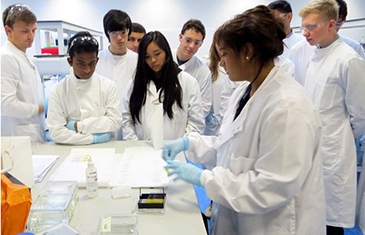
We are delighted in this cross-faculty and cross-disciplinary training programme with our industrial partners to train the next generation of drug discovery researchers— Professor Michael Barnes, Professor of Bioinformatics. The William Harvey Research Institute, Faculty of Medicine and Dentistry
Please see below details of the available projects for the 2025-26 intake. Please note the application deadline as listed per project and ensure your application is submitted in-time. Available projects are open to candidates who meet the UKRI terms and conditions, and are classed as Home for tuition fee purposes. Further details in the project descriptions below.
Each project has a supervisor based at Queen Mary, and engagement from Industry, including the option for a placement. The level of industry engagement varies depending on the nature of the project. We suggest you review each project description to learn more about the proposed research. Once you have identified your top project, you can submit an application via the Apply page. Note, you will be asked to identify your chosen project, and a maximum of 1 other project; you cannot apply for more than 2 projects, so we recommend you consider your choice carefully, ensuring that it is the right fit for you and your research aspirations.
Points to consider when reviewing projects:
- Is the project a good fit for my research experience to-date, and my research interests?
- Do I have the necessary background knowledge, or could I reasonably acquire this through targeted training on the programme?
- What attracts me to this project, and which part of the project most excites me?
- Does the supervisory team seem a good fit for me, and what makes me want to work with them?
Multimodal and multi-scale foundation models for human biology
Multimodal and multi-scale foundation models for human biology
This project is to start in January 2026.
Application Deadline: 23rd November 2025
Background
Foundation models are transforming understanding of biology. These are vast models, often trained on broad data at scale—such as massive corpora of text, images, or multimodal biomedical data—that can be adapted to a wide range of downstream tasks in medicine without starting from scratch. Examples include classifying cell state changes in disease and predicting drug interactions or patient outcomes. By leveraging their extensive pre-training, foundation models can improve and accelerate drug discovery.
Data encompasses drastically different modalities, from single cell transcriptomics in disease and healthy tissues, to routinely available clinical data. Integrating this multimodal data requires sophisticated fusion techniques to create a unified, semantically coherent representation, ensuring that the model leverages the complementary insights from each source without being overwhelmed by differences in format or noise. Furthermore, the multiscale nature—data spanning from molecules (genomics) to cells (pathology) to whole organs (imaging) to patient populations—demands architectures capable of aligning features across these vastly different levels of abstraction.
Research Objectives
The PhD will be centred around three objectives:
- Develop methods that move beyond mere feature concatenation to create a semantically meaningful, shared latent space where different data types (images, text, time-series, genomics) and scales (molecular, cellular, organ, system) are intrinsically linked. This might mean designing foundation model architectures that use cross-attention mechanisms and multi-stage fusion, for example, to explicitly model the interactions and dependencies between modalities, rather than simply processing them in isolation.
- Investigate methods that capture knowledge at different scales. For instance, architectures that process images from the cellular level (pathology) up to the organ level (radiology) and connect these features to the final patient-level representation.
- Investigate interpretability methods to ensure clinical relevance and trustworthiness.
Collaboration and Training Environment
This project is a unique collaborative partnership between Queen Mary University of London (QMUL), a top-tier research institution, and MSD (Merck Sharp & Dohme), one of the world's leading pharmaceutical companies. Students involved will gain an unparalleled, dual-perspective experience, benefiting from exposure to both cutting-edge academic research and the rigorous demands of the industry research environment. This comprehensive approach will equip candidates with valuable expertise in applying advanced computational methods to solve real-world biomedical challenges, significantly enhancing their scientific skills and professional career prospects.
Eligibility and Applying
We are looking for highly motivated individuals who are passionate about contributing to new discoveries in drug discovery bioscience through the application of the latest techniques in AI and data science.
Ideal candidates will have a grounding in both a natural science and data science, e.g. through a Master's degree or work experience in a subject such as bioinformatics or computational chemistry. Alternatively, you may have, for example, a first-class degree in computer science followed by biochemistry experience, or vice versa (qualifications and evidence thereof must be obtained before January 2026). You will be confident in performing data wrangling and analysis in a language such as Python, R or C++. Effective communication skills are essential.
We particularly encourage students from groups that are currently underrepresented in postgraduate science research, including black and minority ethnic students and those from a socio-economically disadvantaged background.
The studentship will cover UK tuition fees, UKRI stipend (currently £22,780) and a consumables allowance for a period of 4-years (pro-rata for part-time), and is open to candidates who meet the UKRI eligibility criteria for home students. This typically means the candidate will have unrestricted access on how long they can remain in the UK (i.e. are a British National, have settled, or pre-settled status, have indefinite leave to remain etc.) and have been living in the UK for the 3 years immediately prior to studentship starting. Candidates who would be classed as International are unfortunately not eligible for this opportunity.
Please see the Apply Pages for further details on how to submit an application.
Supervisors:
- Professor Venet Osmani - Professor of Clinical AI and Machine Learning, Digital Environment Research Institute, QMUL
- Dr Kirill Shkura - Systems Biologist and Data Scientist, MSD
Project Partner: MSD