
Winners of Queen Mary’s Education Excellence Awards and President and Principal’s Prizes announced
Yesterday (Thursday 23 October), Queen Mary University of London recognised and celebrated the winners of the 2024/2025 ‘Education Excellence Awards’ and ‘President and Principal’s Prizes’.
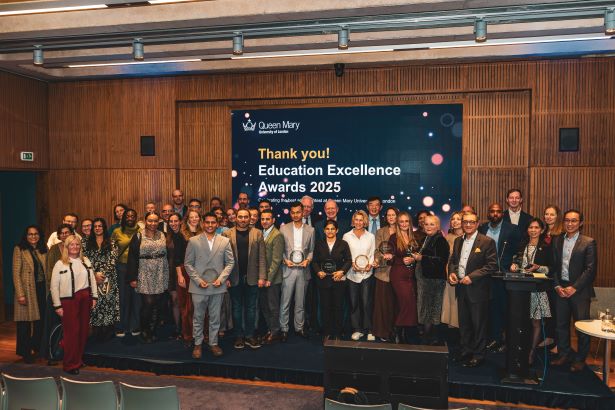
Group photo of Education Excellence award recipients
These awards and prizes celebrate the innovative, collaborative, and pioneering approaches Queen Mary staff are taking when it comes to creating and delivering education excellence across the University.
Winners included those developing new ways to enhance the student experience, colleagues pioneering co-creation of curricula with students, and individuals putting inclusivity at the heart of their education practices.
Speaking on the event, Professor Colin Bailey, CBE, President and Principal of Queen Mary said: “Congratulations to all those who won an award or prize this evening, and also to everyone who was nominated. The calibre of nominations we received this year was exceptional, and it made selecting winners incredibly difficult. This challenge is testament to the dedication, commitment and creativity of Queen Mary staff when it comes to ensuring we consistently deliver a world-class education to our students.
“From innovative teaching methods, to embedding sustainability in the curriculum, our staff are thinking differently about what it means to deliver education excellence. I’m particularly proud to see many of this year’s nominees and winners are working to make our education more inclusive, something which has been at the heart of Queen Mary’s aims and ambitions throughout our 240-year history.”
Education Excellence Awards winners
Faculty of Medicine and Dentistry
Special recognition award: Dr Ava Kanyeredzi, Wolfson Institute of Population Health
Dr Ava Kanyeredzi, who sadly passed away in August 2025, was known for her consistent and deep commitment to student-centred, inclusive learning. As a Director of the MSc in Psychological Therapies, Ava was skilled at making sure all students could access high-quality learning in a manner that would ensure they did their best work. She also shared her educational values with her colleagues, who learnt much about inclusive online education through working with her.
Jessica Carter, Institute of Health Sciences Education (IHSE)
Jessica provided outstanding leadership to the Clinical Education Apprenticeship within the IHSE. From supporting programme development, building administration processes from scratch, collaborating with colleagues, to taking a student-focused approach, her work is a key part of this programme being recognised as ‘Outstanding’.
Dr Ali Nankali, Institute of Dentistry
Under the recent leadership of Dr Ali Nankali, the MSc in Dental Science for Clinical Practice has evolved from a period of low enrolment to now exceeding admissions targets by more than 100 per cent. This achievement reflects the collective effort of the team, innovation in selected modules and assessments, the integration of digital technologies, and the creation of a supportive and engaging learning environment.
Science and Engineering Foundation Programme
Led by Dr Sushma Saksena; Dr Devina Raval; Dr Sasha Howard; Tom Schindler; Jen Ogden; Rozina Hashmi; Institute of Health Sciences Education
This team addressed the need for fairness, transparency, and inclusivity in the Specialised Foundation Programme nomination process. By incorporating national criteria, comprehensive guidance, clear communication, clear feedback and more, they achieved greater student confidence, enhanced fairness, improved trust, and stronger collaborations.
Professional Services
Rachel Hacking, Advice and Counselling; Rhianna Skeates, Careers and Enterprise
The Transition to Work employability programme, co-designed and delivered by the Careers and Advice & Counselling teams, addressed a provision gap for international postgraduate students to accelerate their confident entry to the UK labour market. The model is informing a Student Employability Toolkit, and a train-the-trainer pathway is being developed for wider adoption.
Sustainability module team, cross University
Led by Dr Sayed Elhoushy; Professor Ishani Chandrasekara; Dr Stephanie Fuller; Zoe Sturgess; Naoshin Haque; Josefina Infante Kozarow
The ‘Sustainability Transformation through Research, Education, and Action at Queen Mary’ (STREAM) project involved staff and students from across disciplines coming together to explore how we embed sustainability in the curriculum. Grounded in the UN Sustainable Development Goals, the team co-designed new teaching materials, workshops, and digital learning resources and developed a new course, ‘Foundations in SustainAbility’.
Humanities and Social Sciences
The Education and Student Experience teams in Geography and Environmental Science, History and Politics and International Relations – now the School of Society and Environment
Led by Dr Shreyaa Bhatt; Professor James Esson; Dr David Geiringer; Professor Gemma Harvey; Dr Leslie James; Dr William Monteith; Professor Alastair Owens; Dr Dan Peart; Dr Chris Sparks; Dr James Strong; Professor Philippa Williams; Professor Geraldene Wharton
From 2023-2025, the Departments of History, Politics and International Relations and Geography and Environmental Science saw transformative improvements in National Student Survey outcomes. They achieved this by implementing tailored strategies to increase response rates, amplify student voice and enhance areas like,academic support, and assessment and feedback.
Dr Ernesto Vargas Gil, School of the Arts
In Summer 2025, Dr Ernesto Vargas Gil directed the Language Centre’s EAP Summer Pre-Sessional provision for 415 students across three intakes with over 20 tutors, achieving exceptionally high satisfaction scores through calm, solution-focused leadership that balanced academic quality, fairness, and staff wellbeing.
Nicola Georgiou, School of Law
‘From Crime Scene to Court’ is an interdisciplinary module designed to expose law students to the scientific dimensions of forensic evidence and equip them with skills they’ll need when engaging with expert witnesses. By using forensic science as a case study of the intersection between law and science, it raises issues of accuracy, reliability, and fairness.
Dr Veronica Veleanu, School of Economics and Finance
Veronica has made an outstanding contribution to postgraduate education at SEF through her leadership in employability-focused initiatives within the postgraduate programmes. She has systematically reorganised the School’s employability offer for postgraduate students, with the new activities tailored to the diverse needs of students and embedded in a curriculum that actively prepares students for their future careers.
Science and Engineering
Science and Engineering Foundation Programme
Led by Sarahlouise Lawrence; Rosie Enobakhare; Dr Giorgio Chianello
In 2023, the Science and Engineering Foundation Programme was fully restructured with the aim to offer a higher value degree, significantly enhance student experience, improve continuation metrics, and improve delivery efficiency. A year later (24/25) the new programme was deployed, achieving its aims and proving very popular among students.
Electronic and Electrical Engineering Undergraduate Teaching Team
Led by Dr Tijana Timotijevic; Dr Kamyar Mehran; Dr Shady Gadoue; Kok Ho Huen; Dr Mahesha Samaratunga
The Electronic and Electrical Engineering Undergraduate Teaching Team delivers an outstanding, inclusive educational experience that equips students with technical, practical, and professional skills for a rapidly evolving industry. Through curriculum redesign, integration of real-world challenges, and more, the team has enhanced engagement, satisfaction, and progression rates.
Dr Justin Ward, School of Mathematical Sciences
Dr Justin Ward has made multiple contributions to excellence in education and student support through the development and delivery of two new modules and new processes for advising students. The outcomes of his work are excellent, particulary in relation to advising students, which has led to improved exam attendance and pass rates.
President and Principal’s Prizes
The teams delivering Queen Mary Apprenticeships
Led by Professor Anthony Michael; Marissa Bidwell; Rachel Henry; Nathalie Grey; Richa Dave; Joseph Okitikpi; Susanne Steck; Professor Roberto Veneziani; Professor Francis Breedon; Professor Rachel Male; Dr Radoslawa Nikolowa; Jessica Carter; Professor Erik Blair; Professor Michael Page; Mariam Lowe; Pooja Kanani; Jamie Hilder; Dr Rachel Appleton; Vanetta Cayenne; Eileen O'Gara; Oscar Stephenson; Alina Liszewska; Joe Widdecombe; Laura Debrincat; Ellie Watson; Adam Streames
In October 2024, the Queen Mary Apprenticeship Teams led the preparation and delivery of an Ofsted inspection, where the University achieved the highest possible score of ‘Outstanding’ across all areas. The inspection required collaboartion between academic and professional services staff, the gathering of hundreds of pieces of evidence at short notice and dedication and agility from the team.
Led by Professor Yue Chen; Kok Ho Huen; Professor Michael Chai
The ‘Fresher to Thriver’ programme addresses student transition, belonging, and engagement through a student-centred, inclusive approach. The programme has engaged over 1,880 first-year students across London and Beijing, strengthening inclusive education, embedding graduate attributes, innovating pedagogy, and supporting retention and engagement. Early evaluation is highly positive, with over 85% of surveyed students reporting stronger belonging and enjoyment.
EduMark AI
Led by Dr Deepshikha; Professor Conrad Bessant; Dr Li Wang; Dr Xinru Deng; Dr Giuseppe Viola; Hashir Hamid
EduMark AI represents a breakthrough in educational assessment through multi-disciplinary collaboration and addresses a core educational challenge: the heavy workload associated with assessment and feedback. By leveraging ethical AI tools in alignment with structured rubrics and prompt frameworks, the project reduced grading time by up to 60% while improving feedback quality, specificity, and timeliness.